

By Dr Hamizie Tahir
A football match draws our attention to the pitch. Yet medical planning has to look much further: into the stands, along the access routes and towards the hospital that may receive a patient.
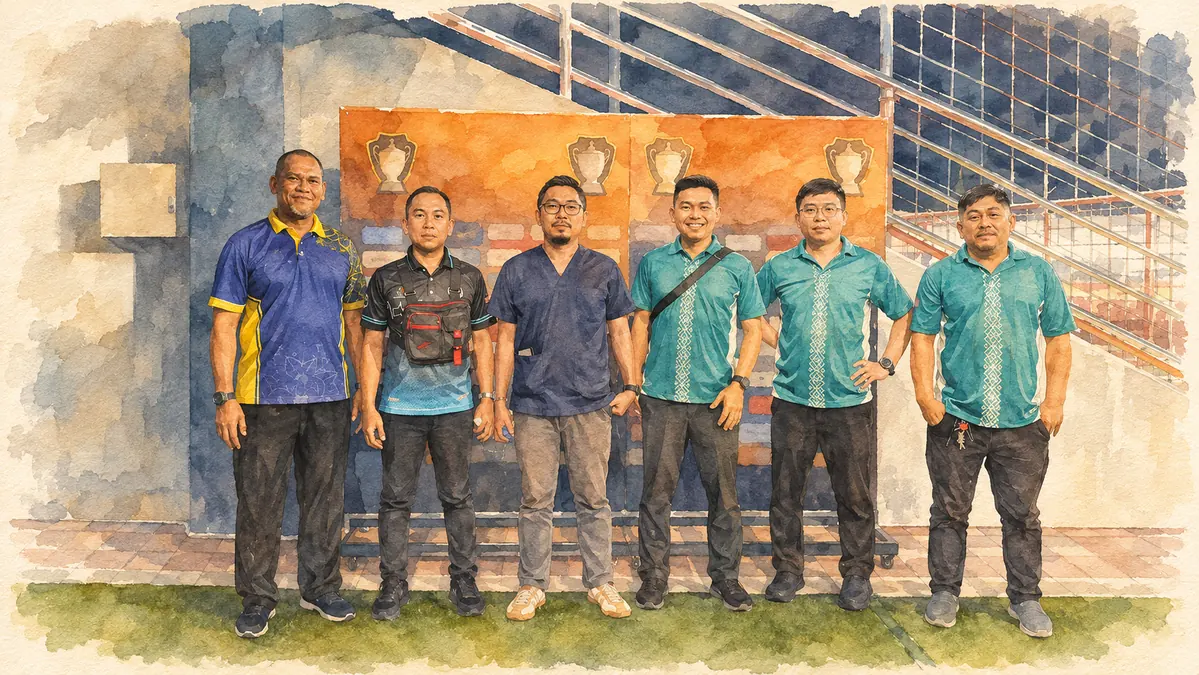
The community service report for the UNIFI Piala Malaysia medical standby at Stadium Likas, Kota Kinabalu, on 17 January 2025 records coverage for football players, VVIPs and members of the public. It provides a useful starting point for a wider question: what does it take to prepare medical care for a stadium event?
The answer involves more than placing an ambulance outside the ground. Research and Malaysian policy describe a service built around risk assessment, trained personnel, communication and a clear route to further care.[1] [5] [6]
Medical cover must reach beyond the pitch
A stadium brings together people with different ages, health needs and levels of physical activity. Players require access to care, but spectators and staff must also be considered.
A 2025 scoping review examined 22 studies of medical presentations at stadium and arena events. Reported presentation rates ranged from one to 24 patients per 10,000 spectators, with a median of 3.8. The median hospital transfer rate was 0.35 per 10,000 spectators.[1]
These figures describe the studies reviewed; they are not a forecast for Stadium Likas or a staffing formula for Malaysian events. Their variation is itself useful: medical demand differs between events, venues and health-service arrangements. Copying another stadium’s provision without assessing local conditions can miss important needs.[1]
The relevant question is therefore not simply, “How many people are coming?” It is also, “What risks do they face, and how will help reach them?”
A medical plan has to work on the ground
An emergency action plan turns preparation into agreed responsibilities. It identifies who leads, who responds, where equipment is kept and how a patient will leave the venue.
Maher and Weiss’s review of emergency action planning in American football describes personnel, emergency equipment, venue-specific procedures, transport, rehearsal and documentation as core elements.[2] Although that sporting setting differs from Malaysian association football, these organisational principles offer a useful framework for local adaptation.
For a stadium team, practical questions include:
- How will someone report an emergency and give an exact location?
- Who will guide responders through the crowd?
- Which gate can an ambulance use?
- How will a stretcher reach someone in the stands?
- What happens if the transporting ambulance leaves while the match continues?
A written plan needs to be understood by the people delivering it. Briefings and rehearsals help identify gaps before an emergency tests the arrangements.[2]
Why readiness for cardiac arrest matters
Medical planning must allow for rare emergencies with serious consequences. Sudden cardiac arrest is one example.
A European consensus document on cardiovascular safety at sports arenas recommends a comprehensive medical action plan, cardiopulmonary resuscitation capability and accessible automated external defibrillators, or AEDs.[3] Equipment must be connected to a response system: people need to know where it is and how to bring it to the patient.
A ten-year retrospective study at Gillette Stadium in the United States recorded 21 out-of-hospital cardiac arrests across more than 7.7 million attendances at 115 football games. Ninety-five per cent were witnessed, and 47 per cent of patients had good neurological survival at 30 days.[4]
This was an observational study at one venue. It does not prove that a particular staffing arrangement caused those outcomes, nor does it predict results elsewhere. It does show why medical teams must remain prepared even when serious incidents are uncommon.
The Malaysian policy framework
Malaysia’s Ministry of Health (MOH) Emergency Medicine and Trauma Services Policy, published in 2012, addresses mass gatherings and major-event medical coverage in Section 8.5.[5]
It identifies selected situations requiring coverage, including events with an elevated possibility of medical emergencies. Crucially, Section 8.5.2 requires risk assessment before an appropriate coverage team or response plan is assigned. The section also refers to Director-General of Health Circular No. 2/2007, concerning MOH medical and health protection coverage.[5]
This supports a risk-based approach rather than treating every event as requiring an identical team. These are identifiable published policy references, not a claim that they constitute the latest complete stadium protocol. Event organisers and clinical leads should confirm applicable current instructions with the responsible MOH service, State Health Department and venue authorities.
Malaysian experience also supports early coordination. A report in the Malaysian Journal of Medical Sciences described medical standby planning for a youth programme through job descriptions, risk analysis, resource planning, contingency arrangements and a tabletop exercise. It highlighted collaboration between agencies during planning and delivery.[6] Its lessons concern organisation; the camping event’s team size should not be copied as a stadium staffing standard.
Putting the guidance into practice
For organisers, the following planning checklist brings together the Malaysian policy principle and the emergency-planning literature. It is an operational summary, not a reproduction of an official MOH checklist.[2] [5] [6]
Assess the event. Review the expected attendance, activities, layout, environmental conditions and access to further care. Use the assessment to inform resources.
Agree on leadership and responsibilities. Identify the medical lead and establish how clinical staff, organisers, security personnel and ambulance services will work together.
Check access and equipment. Confirm treatment locations, emergency equipment, AED availability and routes for responders and patient movement.
Test communication. Agree on how an emergency will be reported, how locations will be described and what backup arrangement will be used if communication fails.
Plan hospital transfer. Establish the escalation and receiving arrangements, transport route and how event coverage will be maintained if resources leave the venue.
Brief, rehearse and review. Walk through the response, record medical encounters appropriately and discuss what needs improvement after the event.
The value of this preparation may be difficult to see from the stands. A clear access route or a well-understood radio message rarely attracts attention. Yet these details help turn available personnel and equipment into a coordinated service.
The crowd comes to watch football. Behind that experience, medical standby is the work of being ready: knowing the risks, knowing the plan and knowing how to act together when help is needed.
References
- Sultana N, Crilly J, Ware RS, Ranse J. Factors influencing patient presentation and transfer to hospital rates during mass-gathering stadium events: a scoping review. Prehospital and Disaster Medicine. 2025;40(2):101–113. https://doi.org/10.1017/S1049023X25000287
- Maher JD, Weiss L. Development and implementation of an emergency action plan in football. HSS Journal. 2023;19(3):358–364. https://doi.org/10.1177/15563316231165498
- Borjesson M, Serratosa L, Carre F, et al. Consensus document regarding cardiovascular safety at sports arenas: position stand from the European Association of Cardiovascular Prevention and Rehabilitation (EACPR), section of Sports Cardiology. European Heart Journal. 2011;32(17):2119–2124. https://doi.org/10.1093/eurheartj/ehr178
- Goldberg SA, Battistini V, Cash RE, et al. A retrospective review of out of hospital cardiac arrest at Gillette Stadium: 10 years of experience at a large sports venue. Resuscitation Plus. 2023;14:100386. https://doi.org/10.1016/j.resplu.2023.100386
- Ministry of Health Malaysia. Emergency Medicine and Trauma Services Policy. Putrajaya: Medical Development Division; 2012. Section 8.5, p. 14; refers to Director-General of Health Circular No. 2/2007. Official policy PDF.
- Zakaria MI, Mohd Isa R, Che Hamzah MSS, Ayob NA. Medical standby: an experience at the 4th National Youth Camping and Motivation Program organized by MAKSAK Malaysia. Malaysian Journal of Medical Sciences. 2006;13(1):43–51. Full text.
Event and image source: Community service one-page report, “Medical Team Standby UNIFI Piala Malaysia”, Stadium Likas, 17 January 2025. The featured illustration is a watercolour interpretation of the team photograph supplied with the report. No patient encounters or clinical outcomes from that event are asserted in this article.



Leave a Reply